
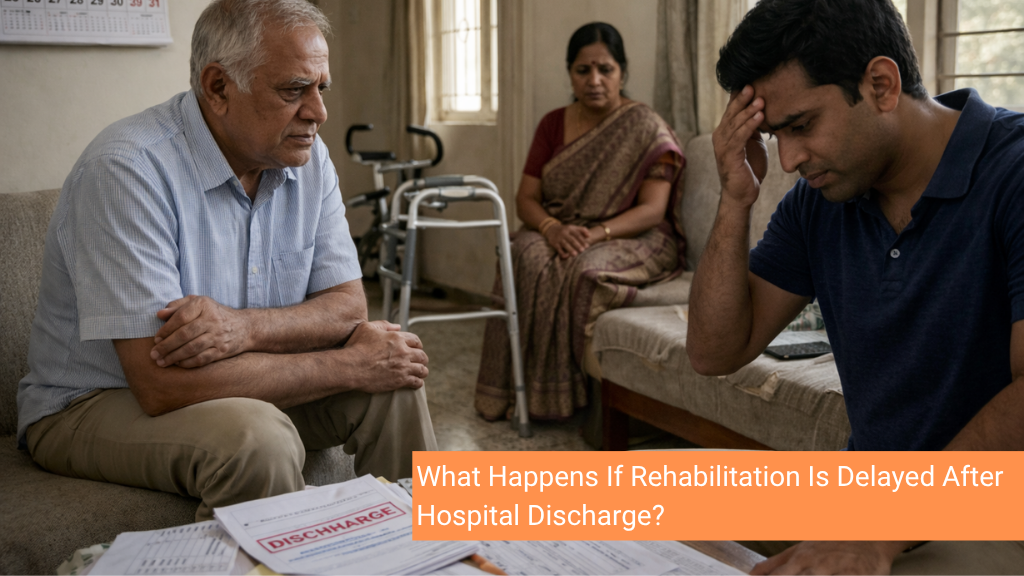
We’ll be repeating the same thing over and over again if we say that recovery is not complete after hospital discharge. Although families of patients are relieved to take them home and provide care, there are more chances of relapse and hospital readmissions. We have also been talking about the significant role of rehabilitation in the recovery process.
In this blog, we’d like to tell you that if you don’t opt for rehabilitation on time, what can happen and how it can affect the physical and emotional health of the patient.
This is not to scare you, but to educate you to enable you to make more informed decisions regarding your health and well-being, as well as that of your ailing loved one.
Before we start listing the disadvantages of delayed rehab, here’s a quick recap on the benefits of rehabilitation. It helps regain strength, mobility, independence, and confidence.
What would be the effect of delayed rehabilitation following discharge?
Delay in rehabilitation following discharge from the hospital may result in slower, more complex, and even partial recovery.
One of the myths is that the patient will heal slowly once he or she comes back home with ample rest. Rest is good at the beginning; however, in the long term, rest is counterproductive to healing.
Muscle weakness, lack of mobility, and loss of endurance are common effects of the body after a stroke, surgery, or a critical illness. Lack of guided rehabilitation will make patients unable to restore their former abilities.
Rehabilitation offers a systematic treatment that assists the patients in restoring power, relearning the movements, and resuming everyday functions safely. This process should not be postponed because it may complicate the process of recovery in the future.
This is what can happen
1-Muscle weakness may progress rapidly.
Rapid muscle loss is one of the greatest risks associated with the delay of rehabilitation. Patients who spend a long time in the hospital, do not move their muscles, and they deteriorate at a rate many times quicker than one would think.
Actually, a patient is likely to lose a lot of muscle power in a matter of a few days as a result of inactivity. This situation is commonly referred to as deconditioning, and even simple tasks such as standing, walking, or going up stairs might exhaust them.
Physiotherapy and guided exercises are the means to ensure the maintenance of muscle strength and restore endurance gradually, which is used in rehabilitation programs. In the absence of these interventions, the patients expose themselves to prolonged weakness, which postpones their recovery to normal lives.
2-Balance and mobility may deteriorate.
Balance, coordination, and movement are problems that a patient goes through once they have been discharged and have suffered neurological damage, either due to a stroke or some brain injury. Early rehabilitation helps the body and the brain to get back to working together.
A lack of timely rehabilitation may lead to the emergence of unhealthy habits in a patient, including fear of falling, etc. It can produce stiffness, joint pain, and loss of movement in the long run.
Close interaction with patients is done to restore safe movement patterns, improve balance, and restore confidence in walking or performing daily activities. The prompt application of rehabilitation can help to reduce the amount of mobility problems on a long-term scale.
3-Increased risk of complications.
Late rehabilitation would also create more possibilities of various medical complications, particularly among patients who are bedridden or immobile.
The usual complications are:
- Stiffness and contractures of joints.
- Bed rest pressure ulcers.
- Blood clots in the legs.
- Difficulties in breathing as a result of a decrease in lung activity.
- Low circulation and edema.
The prevention of these complications by rehabilitation teams is carried out by movement therapy, breathing exercises, positioning, and mobility training.
These complications can arise and complicate the recovery when the therapy is delayed.
4-Freedom can be more difficult to recover.
This is the ultimate recovery goal of so many patients to regain their everyday independence to walk, dress, eat, and carry out daily tasks without support.
By starting rehabilitation early, the therapists put the patients through a process of functional training involving step-by-step recovery of body functions, restoring independence slowly.
When the rehabilitation is delayed, the patients can become more and more reliant on caregivers to perform their daily chores. This addiction may complicate the process of winning the confidence later, both physically and emotionally.
Organized rehabilitation assists the patients in re-training the necessary life skills as well as restoring the feeling of control over their life routines.
5-Mental and emotional health may be affected.
When one is ill or injured, it not only takes time before one can recover physically, but also emotionally.
Patients who have long-term weakness or insufficient progress once discharge takes place can also start to feel frustrated, anxious, or discouraged. More so they can be influenced by feelings of helplessness, which slows down the recovery.
The rehabilitation programs frequently involve psychological support, counselling, and motivation of the recovering individual by therapists who understand and empathize with the recovery process.
Progressing slowly and gradually with the help of structured therapy can play a significant role in motivating patients, raising their confidence, and enhancing their emotional state.
6-The recovery window of the brain is missed.
Early rehabilitation is especially needed in neurological diseases such as stroke or brain injury since the brain possesses a recovery period window.
In the weeks of the posttraumatic period, the brain is better placed to restructure itself and form new neural links. This is referred to as neuroplasticity, which enables patients to re-learn functions that they have lost.
Procrastinating the process of rehabilitation at such a vital stage can impair the brain’s ability to regain some of the skills that are essential and therefore makes the recovery process more difficult over time.
It is time to stop thinking of rehabilitation as a luxury or an option and consider it as one of the most important aspects of recovery. This concept, which is well accepted in the West, now needs to be given more importance back home for the health and well-being of patients who deserve to return to life with the same old gusto and motivation.

We are India’s first comprehensive continuum care provider. We provide multidisciplinary out of hospital care to acute and post-acute and chronically ill patients at our critical care facilities and your home.
- Sukino Healthcare
- Sukino Healthcare
- Sukino Healthcare