
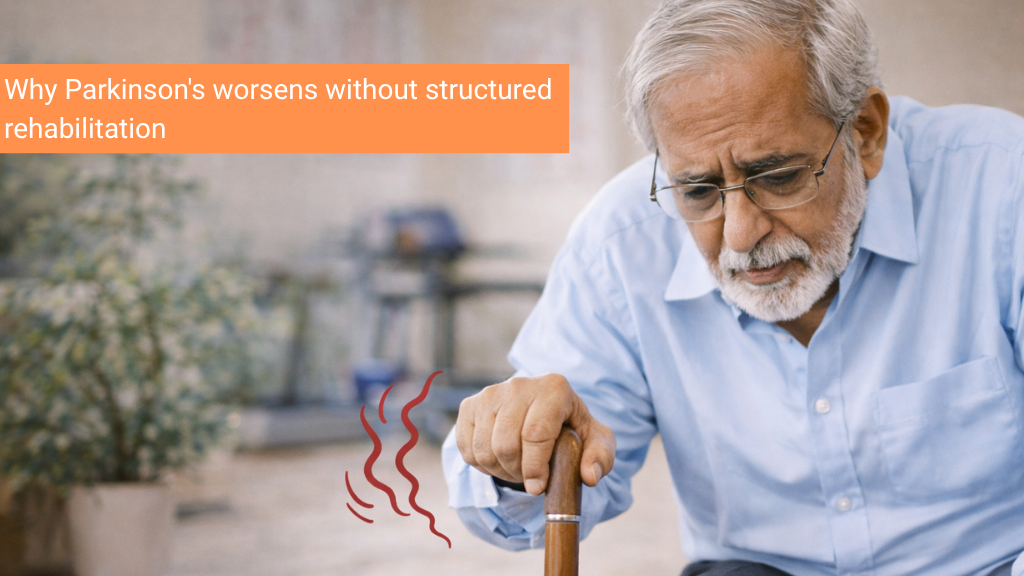
Parkinson’s disease is a progressive neurodegenerative (neurological) disorder, which in due course is marked by movement, balance, coordination, as well as cognitive disorders. Even though medications play a significant role in symptom management, they are not the sole element of the care process. There is also a need to formulate rehabilitation (physiotherapy, occupational therapy, and speech therapy). Without it, the patients are likely to lose their physical and functional capacities faster and more easily.
Through this understanding, families and caregivers need to make more informed decisions and give their loved ones improved long-term outcomes.
Table of Contents
ToggleWhy rehabilitation matters
Rehabilitation is not only based on exercise, but it is a goal-focused, holistic method to ensure mobility, independence, and quality of life. It treats various symptoms of the disease at the same time, such as:
- Muscle strength.
- Flexibility.
- Balance and coordination.
- Posture.
- Speech and swallowing.
- Daily functional skills.
How rehabilitation helps
In the absence of this organized help, the body becomes unadaptive to the condition, thereby enhancing physical degradation.
This is what happens:
1-Faster Loss of Mobility
The decreased mobility is one of the first effects of the absence of rehabilitation. The stiffness and slow movements are already being experienced by patients with Parkinson’s. Lack of routine guided movements results in weaker muscles and stiffer joints, and movement becomes more and more difficult.
Over time, this can lead to:
- Difficulty walking.
- Reduced stride length.
- Higher cases of freezing (freezing in the middle of movement).
2-Increased risk of falls
One of the main characteristics of Parkinson’s disease is balance impairment. In the absence of specific balance training, the likelihood of falls among patients is tremendously high and may lead to fractures, hospitalization, and loss of confidence.
Rehabilitation programs contain:
- Gait training.
- Balance exercises.
- Postural correction.
3-Weakness and rigidity of muscles
One of the unpleasant symptoms of Parkinson’s is muscle rigidity. In cases of patients who fail to practice established stretching and strengthening exercises, the muscles become even tighter, which causes pain and diminished range of motion.
This creates a vicious cycle of:
- Reduced movement.
- Increased rigidity.
- Stiffness.
Rehabilitation interrupts this cycle by ensuring that muscles are active and flexible to topple down quickly.
4-Deterioration of daily functioning
Even basic lifestyle tasks like dressing, eating, or writing become much more challenging as Parkinson’s disease advances. Patients can lose the ability to do these tasks without occupational therapy.
Systematic rehabilitation is aimed at:
- Enhancing hand coordination.
- Teaching adaptive techniques.
- Effective use of assistive devices.
With this, patients usually end their reliance on caregivers sooner than required, and this impacts their dignity and quality of life.
5-Difficulty in speech and swallowing
Parkinson’s affects not only movement but also affects speech and swallowing. A large number of patients are left with a low voice, slurred speech, or difficulty in swallowing, which may result in malnutrition or aspiration.
Speech therapy is very important for:
- Strengthening vocal cords.
- Improving clarity of speech.
- Learning safe swallowing.
These problems are likely to deteriorate in a short period without organized intervention, which may result in severe health problems.
6-Mental and emotional impact
Parkinson’s disease comes with physical deterioration that is normally surrounded by emotional predicaments such as depression, anxiety, and social isolation. The loss of independence by the patients can affect their self-esteem and drive.
Rehabilitation programs include:
- Routine and structure.
- Social interaction.
- The feeling of development and success.
In the absence of this support, patients tend to become isolated, and this further increases mental and physical deterioration.
7-Less effectiveness of drugs
Interestingly, rehabilitation also increases the efficacy of the medications of Parkinson’s. Exercising enhances blood flow and enables the body to take medication more effectively.
When patients are inactive:
- Drugs might appear inefficient.
- The control of the symptoms is irregular.
This may result in unwarranted dosage increments or combining with other drugs that bring about adverse effects.
The significance of the early intervention.
Among the most widespread myths about rehabilitation is the fact that only in the later stages is such a procedure required. As a matter of fact, the sooner the intervention, the slower the progression of the disease, and the more time can be enjoyed without the need to be dependent.
Consistency is key. Sporadic or impromptu exercise is not sufficient. Patients benefit most from:
- Personalized therapy plans.
- Frequent surveillance and manipulations.
- Multidisciplinary care.
There is a way to live A better life
Although Parkinson’s disease is incurable, it can be controlled successfully with an appropriate strategy. Formal rehabilitation makes patients self-reliant enough to be active and live with dignity. It gives patients a greater opportunity to maintain their capabilities and live a more productive life in the years to come. Otherwise, the deterioration tends to be quicker, more drastic, and harder to control.
To sum up, rehabilitation is not a choice in the treatment of Parkinson’s; it is a necessity and one of the most effective choices that patients and caregivers make when dealing with the disease.

We are India’s first comprehensive continuum care provider. We provide multidisciplinary out of hospital care to acute and post-acute and chronically ill patients at our critical care facilities and your home.
- Sukino Healthcare
- Sukino Healthcare