
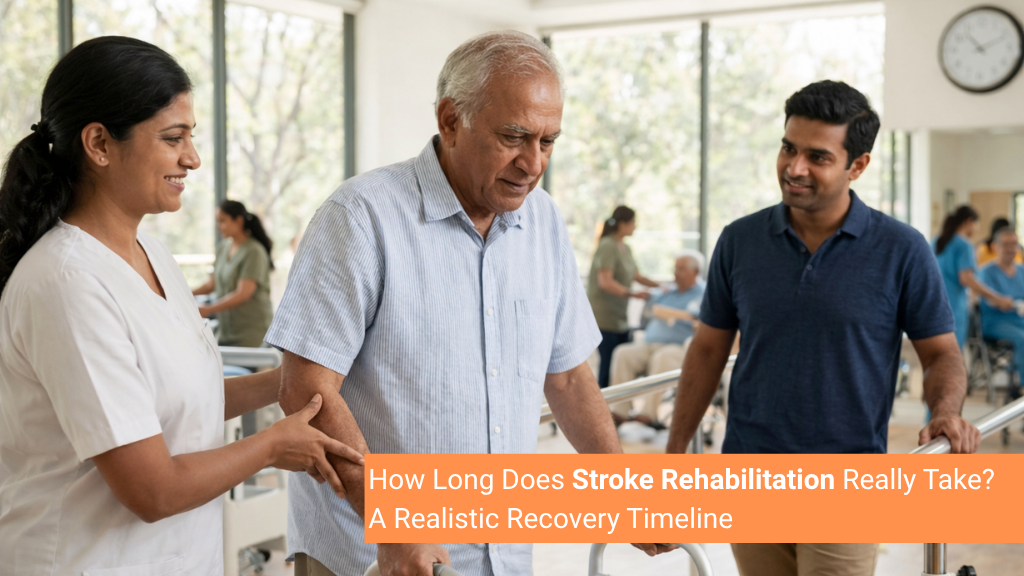
For families dealing with a stroke patient, one question holds a lot of importance after the primary treatment is over. “How much time will it take for the patient to recover completely?”
This is common, especially after they see that the patient is now stable.
Experts, however, wish to convey that recovery from stroke never follows a specific timeline.
For some, improvement can occur quickly. For others, it may take months or even years. The most important thing is to realize that recovery is a gradual process, and rehabilitation is vital throughout all phases.
Table of Contents
ToggleThe different stages of recovery
This is what recovery generally looks like and what role rehabilitation plays in it.
1-The First Few Days: Leveling the Body and the Brain.
Medical stabilization is the primary concern right after a stroke. The physicians attempt to reduce brain edema, avoid a secondary stroke, and monitor critical functions.
This is the phase in which the healthcare teams begin to assess the stroke impact that a patient has p experienced. Some patients may experience weakness on one side of the body, speech problems, difficulty in swallowing, as well as memory and thinking problems.
Even at this point, rehabilitation can commence. Straight movements, positioning, and breathing support can assist in the prevention of complications (stiffness, blood clotting, or pressure injuries).
Although a family may have a desire to see the situation improved soon, the first few days are more marked by preserving the brain and getting ready to move to the next level of recovery.
2-Weeks 1-4: Early Recovery Begins
The initial month following a stroke is usually one of the most significant stages in the recovery process. At this stage, neuroplasticity, which is the process by which the brain adapts and restructures itself, takes place.
Rehabilitation aims at assisting patients toward recovery of simple skills, including:
Sitting up without support
Sitting up or assisted standing.
Moving the arms or legs
Enhancing swallowing and speech therapy.
Engaging in basic everyday activities.
A combination of physiotherapy, occupational therapy, and speech therapy is normally presented by the therapists based on the needs of the patient.
These are the weeks when many patients start making any noticeable improvements. Nevertheless, the healing process is not usually a straight line. There are days when it is encouraging, and there are those days when it is frustrating. It is important to be consistent and patient.
3-Months 1-3: The Busiest Phase of Recovery.
The initial three months following a stroke can be said to be the period most active in rehabilitation. This is the period when the brain is most sensitive to therapy, and therefore regular rehabilitation could be of great help.
The patients can start pursuing more sophisticated objectives, like:
Walking longer distances.
Enhancing coordination and balance.
Doing daily chores.
Speaking more clearly.
Perform cognitive functions such as attention and memory.
To a great number of stroke survivors, this is the point at which they begin to gain some kind of independence. Tasks such as eating, changing clothes, or transferring to the house can become simpler with time.
The structured rehabilitation programs are particularly crucial at this phase as they assist in the relearning of the skills by the brain and the formation of new neural pathways.
4-Months 3-6 Strengthening and Relearning Skills.
In the initial few months, recovery happens at a lesser rate. This does not imply that there is no progress anymore. Rather, it becomes a question of perfecting the movements and gaining strength.
Patients may work on:
Enhancing walking stability.
Increasing muscle strength.
Acquisition of fine motor skills, e.g., writing or buttoning clothes.
Using more articulate speech and communication.
Developing memory and problem-solving abilities
This is also the period when the patients start to adjust emotionally to life following the stroke. The confidence improves since they can do things, and most of them resume engaging in social activities or hobbies.
5-Six months and above: Long-term Rehabilitation.
One of the myths is that stroke recovery ceases after half a year. The truth is that most of the patients keep on improving even after this time.
Years following a stroke, the brain can still adapt and learn well. Further rehabilitation, exercise, and cognitive training may be used to assist patients in sustaining the progress and even recover more functionality as time progresses.
At this stage, rehabilitation usually involves the enhancement of the quality of life. Patients can strive to achieve such objectives as going back to work, driving a car, or performing their daily activities without assistance.
Why is recovery different for everyone?
The rate at which a person recovers depends on several factors, including:
- The severity of the stroke
- The part of the brain that was affected.
- Age and overall health condition of the patient.
- The speed with which rehabilitation kicks in.
- The intensity of therapy.
- Emotional support.
Two individuals who have apparently similar strokes can heal in different ways. This is what makes doctors concentrate on personalized rehabilitation programs instead of setups.
The Role of Structured Rehabilitation
Quality and consistency of rehabilitation are one of the largest determining factors of recovery.
The rehabilitation of stroke patients is not only about exercises. It involves a team that is coordinated and comprises physiotherapists, occupational therapists, speech therapists, neurologists, psychologists, and rehabilitation specialists.
They jointly develop a tailored recovery strategy that supports the physical mobility, speech, thinking, and emotional state.
This systematic procedure aids in restoring the independence of patients in steps that decrease the chances of complications.
Recovery is a slow process of small wins. It occurs in tiny but significant steps. Perhaps that is the biggest thing that families and patients should keep in mind: that such events might be minute, yet they are great steps in healing. Hence, it may be right to conclude that the process of recovery cannot be quantified just in months or years, but by each progressive move in the process.

We are India’s first comprehensive continuum care provider. We provide multidisciplinary out of hospital care to acute and post-acute and chronically ill patients at our critical care facilities and your home.
- Sukino Healthcare
- Sukino Healthcare
- Sukino Healthcare