
Table of Contents
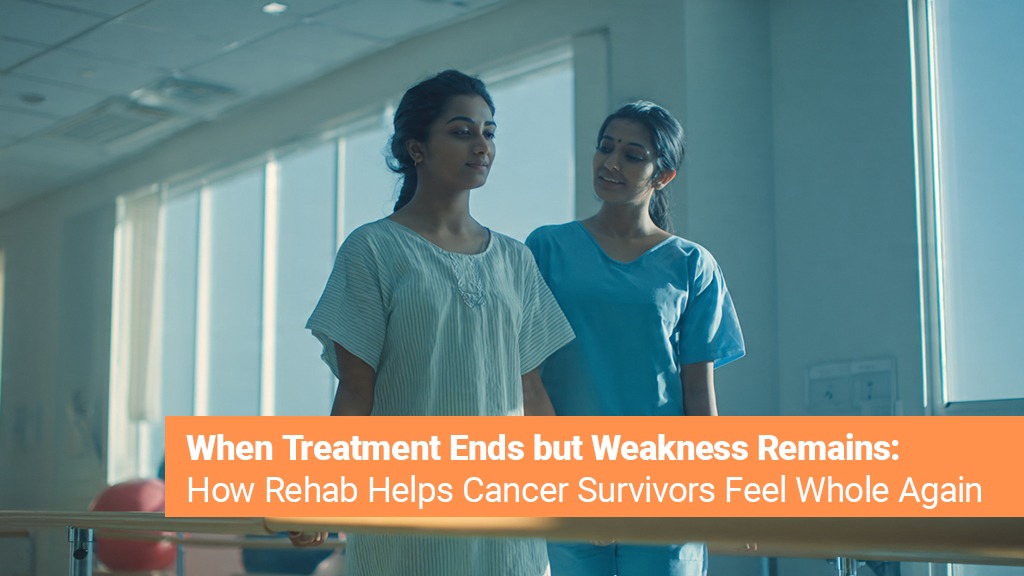
ToggleWhen Treatment Ends but Weakness Remains: How Rehab Helps Cancer Survivors Feel Whole Again
The end of treatment is like a finish line for most cancer survivors. The words “You’re done” bring tremendous relief to family and friends, and everyone, including the patient, expects life to return to normal. But here’s the twist. For the majority of survivors, this marks the beginning of a more muted, more perplexing stage.
Once the cancer has been removed, the body experiences strange symptoms. Simple tasks feel harder. Exhaustion creeps in. Muscles feel weak, and balance isn’t the same. There may be pain, stiffness, breathlessness, brain fog, or emotional heaviness, which no one is prepared for. This is where rehabilitation can help.
The consequences of cancer treatment
Treatments of cancer are highly efficient in terms of saving lives, but they also may have long-term effects. Mobility or posture can be affected by surgery. Radiation and chemotherapy can impact nerves, muscles, lungs, and the heart. The treatments tend to decrease bone density, strength, and endurance. The long-term stay in hospitals and reduced movements also contribute to deconditioning, or the body being weaker than it was previously.
The survivors of cancer frequently complain:
- Constant tiredness, which cannot be solved by rest.
- Weakness of the muscles and loss of endurance.
- Joint stiffness and pain
- Dizziness.
- Breathlessness.
- Memory loss.
- Lack of focus.
- Fear and anxiety.
Such problems do not always present themselves in the medical documentation but have a profound impact on everyday life. The big question many survivors ask themselves is, ‘Why do I not feel better, although the cancer is gone?’’
There is a difference between survival and recovery
Contemporary oncology has achieved wonders to enable people survive cancer. But survival is only half the battle won. Complete recovery is about regaining strength, independence, and self-confidence.
Unless they receive systematic aid, the survivors can gradually get used to restrictions, such as not using stairs, limiting the number of outings, or even normalizing exhaustion. This may result in additional physical deterioration, loneliness, and depression with time.
Rehab is a way of avoiding this downward spiral. It fills the gap between the medical treatment and the real functioning, where the emphasis is not on the disease, but on the individual.
Getting to know what cancer rehabilitation means
Cancer rehabilitation is a medicalised, individualised approach to assist survivors rebuild strength safely and gradually.
An extensive rehabilitation program may involve:
- Physiotherapy to enhance posture, balance, strength, and mobility.
- Pulmonary rehabilitation to reduce breathlessness and lung deficiency.
- Re-education to reduce stiffness and pain.
- Management of fatigue through training on the balance between work and rest.
- Occupational therapy to make life easier.
- Educational and emotional support to get through the brain fog, anxiety, and lack of confidence.
How rehab helps
With rehab, the process of recovery is one step at a time
1- Fighting fear– One of the most common problems experienced by the survivors is fear. Fear of overexertion. Fear of injury. Fear of overdoing or not doing enough. Rehab assists in substituting fear with knowledge. Survivors are taught what they can do with their bodies once more, and how to stretch those boundaries safely through guided exercises and close supervision. Even small achievements count, such as a longer standing time, no support while walking, the ability to climb the stairs without pauses, or not feeling very tired after a working day.
Over time, strength returns. Endurance improves. Movements feel more natural. The body starts feeling like a home.
2- Combating fatigue in addition to rest– Fatigue related to cancer is not an ordinary fatigue. It does not necessarily get better when one sleeps, and it can be exhausting and unforeseeable. A lot of survivors become frustrated when resting does not work.
Therapists assist the survivors to learn about conservation of energy, pacing, and graded activity, without causing fatigue. Ironically, the right type of activity usually makes people less tired with time, hence the quality of sleep and the state of mind are better.
3-Healing the weakness on the emotional side- The physical weakness is usually accompanied by emotional baggage. Those who survive can miss the person that they once were before cancer. They can be guilty of not being grateful enough or be ashamed of requiring assistance even when the treatment is completed. Rehab does not ignore such sentiments. It makes the survivors feel acknowledged and understood when they are in the company of trained professionals who are aware of their post-cancer issues. Advancement, however gradual, restores confidence. One recovered function supports another, and the healing process continues.
Wholeness is not about going backwards to the past; it is about stepping forward with confidence.
The importance of early rehabilitation
The earlier the rehabilitation commences after the treatment, the more favorable the results are likely to be. Early intervention is useful in averting loss of muscle, joint rigidity, difficulty in breathing, and long-term dependency. It also helps survivors to know that their conditions are not permanent and that they can get better.
Notably, it is not only those with severe limitations who should be rehabilitated. Structured support and help can be useful even to survivors who seem to be fine medically and need to restore their resilience to avoid complications in the future.

We are India’s first comprehensive continuum care provider. We provide multidisciplinary out of hospital care to acute and post-acute and chronically ill patients at our critical care facilities and your home.
- Sukino Healthcare
- Sukino Healthcare
- Sukino Healthcare