
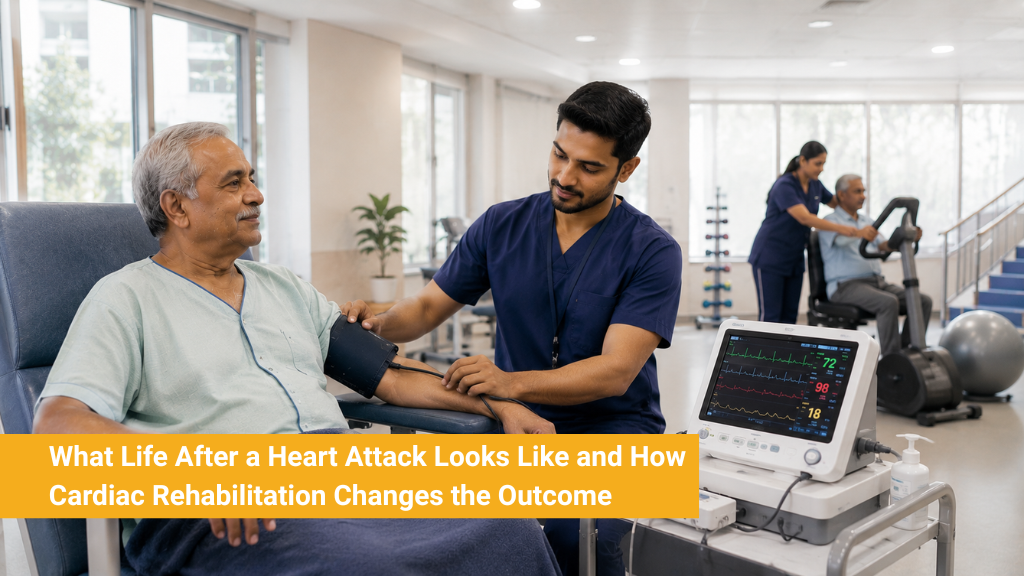
A heart attack is a clinical event with a clear moment of onset and no clear moment of resolution. The stent is placed, the blocked artery is opened, and the patient is discharged with medications, a follow-up appointment, and a set of routine instructions. For many families across India, what follows that discharge is a combination of relief, fear, and uncertainty about what the patient is now allowed to do.
The answer to that question (what is allowed, what is safe, what should be prioritised) is precisely what cardiac rehabilitation addresses. It is a structured, evidence-based programme that begins in the hospital and continues for months after discharge, and the data on its outcomes is unambiguous: patients who complete cardiac rehabilitation live longer, return to work sooner, have better physical capacity, and are substantially less likely to have a second cardiac event than those who do not.
Table of Contents
ToggleWhat a Heart Attack Does to the Heart and What It Does Not
A myocardial infarction occurs when the blood supply to part of the heart muscle is cut off most commonly due to a blood clot forming on a ruptured plaque in a coronary artery. The muscle supplied by that artery begins to die within minutes. How much muscle is lost depends on how quickly blood flow is restored, which is why the speed of hospitalisation matters so profoundly.
What a heart attack does not do is define the rest of a person’s cardiac life. The heart has substantial compensatory capacity. The remaining healthy muscle can adapt. The risk factors that caused the original event (hypertension, high cholesterol, diabetes, smoking, and physical inactivity) are modifiable. And the cardiovascular system responds to graded exercise training with measurable improvements in function and efficiency. This is the physiological foundation on which cardiac rehabilitation is built.
What Cardiac Rehabilitation Actually Includes
Cardiac rehabilitation is not physiotherapy for the heart in the narrow sense. It is a comprehensive secondary prevention programme that addresses every dimension of cardiovascular risk not only exercise capacity.
What a structured cardiac rehabilitation programme includes:
- Medically supervised exercise – graded physical activity that rebuilds cardiovascular capacity safely within monitored heart rate and blood pressure parameters
- Risk factor management – structured support for controlling blood pressure, cholesterol, blood sugar and weight
- Medication education – ensuring the patient understands what each cardiac medication does, why it must be taken consistently, and what side effects to report
- Dietary counselling – practical guidance on a heart-protective diet adapted to Indian food patterns and household cooking
- Psychological support – addressing the depression, anxiety, and fear of re-event that affect a majority of post-MI patients
- Smoking cessation – structured support for patients who smoke, given the direct relationship between smoking and recurrence risk
- Return to activity guidance – clear and graduated advice on resuming driving, sexual activity, work and exercise
- Family education – preparing the household to support recovery and recognise warning signs requiring medical review
Cardiac Rehabilitation at Sukino - Because Surviving Is Only the Beginning
At Sukino cardiac rehabilitation is a structured, medically supervised programme (we never believe to work on a set of general wellness advice). Our teams cover exercise progression, medication management, dietary counselling, psychological support, and family education within a programme designed specifically for the post-MI patient.
The Four Phases of Cardiac Rehabilitation
Cardiac rehabilitation follows a structured progression that begins in the acute setting and continues into long-term self-management:
Phase | What Happens |
Phase 1 (In-hospital) | Begins within days of the heart attack. Gentle mobilisation, basic education, and risk factor assessment. Preparing the patient for discharge. |
Phase 2 (Weeks 1-6) | Outpatient or centre-based programme. Supervised exercise sessions, medication review, dietary counselling and psychological support begin |
Phase 3 (Weeks 6-12) | Exercise intensity progresses based on tolerance. Return to work & daily activity are in a structured way. Lifestyle modification is consolidated. |
Phase 4 (Long-term) | Maintenance of exercise habits and risk factor control. Ongoing monitoring. Independent self-management with periodic clinical review. |
What Families Need to Know and Are Rarely Told
The period following a heart attack is full of questions that patients and families hesitate to ask or that discharge teams do not have time to answer properly.
What families need to know about life after a heart attack:
- Most patients can return to sexual activity within four to six weeks – it is rarely discussed and frequently avoided when it should not be
- Driving is usually cleared at four weeks for private vehicles, subject to cardiologist assessment
- Depression affects many heart attack survivors and significantly increases mortality risk if untreated
- Overprotection (the family preventing all activity to keep the patient safe) is itself a risk factor for deconditioning and psychological decline
- Medications must be taken consistently for life in most cases as skipping or reducing them because the patient ‘feels better’ is one of the most common causes of secondary events
Work return timelines vary: desk-based roles typically within four to six weeks; physically demanding roles require cardiologist clearance and graded rehabilitation
Warning Signs After a Heart Attack That Require Immediate Attention
Cardiac rehabilitation involves progressive exercise under medical supervision but recovery at home carries its own risks. Families should know which symptoms require urgent response and should not be attributed to normal tiredness or the effects of new medication.
Warning signs after a heart attack that require immediate medical attention:
- Chest pain, pressure, or tightness – do not wait to see if it passes
- Breathlessness at rest or on minimal exertion that is new or worsening
- Palpitations – rapid, irregular, or forceful heartbeat
- Dizziness, lightheadedness, or fainting episodes
- Swelling in the legs or ankles that is increasing
- Sudden severe fatigue disproportionate to any activity performed
Any of these symptoms during or after exercise should be reported to the cardiac rehabilitation team immediately and should not be attributed to normal recovery discomfort.
FAQs
Phase 1 rehabilitation (gentle mobilisation and education) begins in the hospital often within 24 to 48 hours of the event if the patient is stable. The structured outpatient programme typically starts two to four weeks after discharge. Starting early is associated with significantly better outcomes: lower rates of hospital readmission, better exercise capacity at six months and reduced mortality compared to patients who begin rehabilitation late or not at all.
Yes and it is essential. Prolonged rest after a heart attack leads to cardiovascular deconditioning, increased anxiety, and a greater risk of a second event. Exercise in cardiac rehabilitation is medically supervised, carefully dosed, and matched to the individual’s current cardiac capacity. It begins with walking at low intensity and progresses gradually based on heart rate and blood pressure response. The goal is a heart that is stronger and more efficient and not one that is protected by inactivity.
Yes the evidence is clear and compelling. Patients who complete cardiac rehabilitation have a lower risk of complications from cardiovascular causes compared to those who do not. They also have lower rates of hospital readmission, better control of modifiable risk factors, and substantially better quality of life. Cardiac rehabilitation is not a supplementary wellness programme. It is one of the most effective interventions in secondary prevention of cardiovascular disease.
Feeling well does not mean the cardiovascular system has recovered or that the risk factors that caused the event have changed. The heart attack itself may have caused myocardial damage that is not yet symptomatic. The plaques and lifestyle factors that precipitated the event are still present. Cardiac rehabilitation addresses these systematically – through risk factor modification, exercise conditioning, and psychological support – in ways that feeling fine simply does not.
Diet plays a central role in secondary prevention, and Indian food is entirely compatible with heart-healthy eating when adapted appropriately. The key modifications involve reducing saturated fat from ghee, oil, and processed foods; increasing fibre through dals, vegetables, and whole grains; managing salt intake; and controlling portion sizes. Cardiac rehabilitation dietitians at Sukino provide guidance that works within the reality of Indian household cooking and not a Westernised dietary framework that bears no relationship to how the family actually eats.
This is one of the most important and least-discussed aspects of post-MI recovery. Families who prohibit all activity, accompany every movement, and treat the patient as fragile create a different but equally real problem (deconditioning, dependence, and psychological decline). The right response is informed encouragement: understanding what activity is prescribed and supporting the patient in completing it, recognising warning signs without reacting to ordinary exertion, and treating the patient as a recovering person, not a permanent invalid.
As a four-phase, multidisciplinary programme that begins during the acute hospital stay and continues through to long-term independent self-management. Sukino’s cardiac rehabilitation teams combine medically supervised exercise progression with risk factor management, dietary counselling, psychological support and clear return-to-activity guidance – coordinated with the patient’s cardiologist throughout.

We are India’s first comprehensive continuum care provider. We provide multidisciplinary out of hospital care to acute and post-acute and chronically ill patients at our critical care facilities and your home.
- Sukino Healthcare
- Sukino Healthcare