
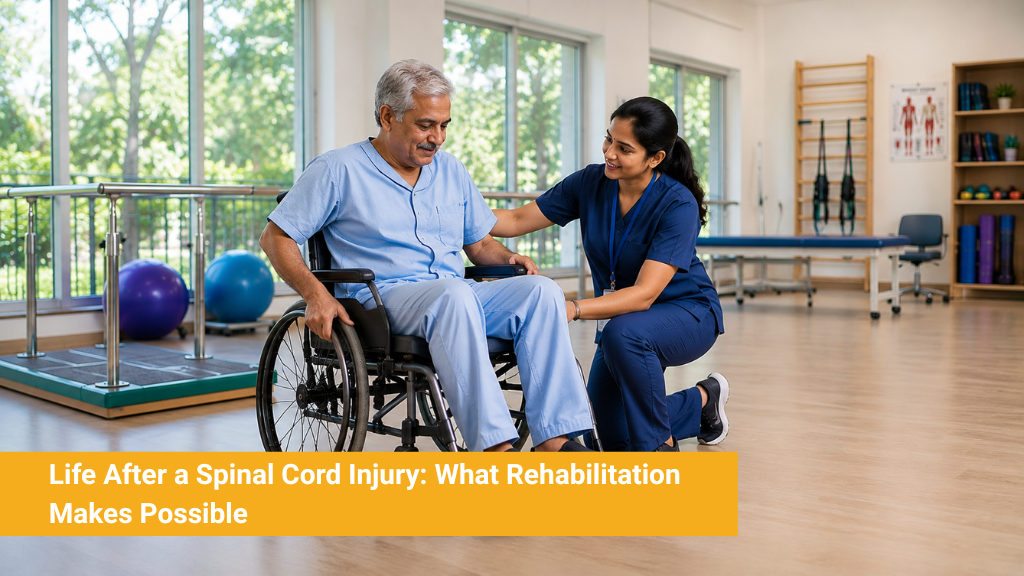
A spinal cord injury reorders everything in hours and sometimes even in minutes. The person who arrived at the emergency department with full movement and sensation may leave the acute ward weeks later with a fundamentally different relationship to their body, their independence and their sense of what the future holds.
What rehabilitation can achieve after spinal cord injury is substantial and families consistently underestimate it. What it cannot reverse, it can frequently work around. The distinction between these two categories is not fixed at the moment of injury. It is shaped by the quality, timing and comprehensiveness of the rehabilitation that follows.
Table of Contents
ToggleUnderstanding the Injury: Why Level and Completeness Matter
No two spinal cord injuries produce identical outcomes. The functional consequences depend primarily on two factors: the level of the spinal cord at which the injury occurred and whether the injury is complete (no motor or sensory signals pass below the damage) or incomplete (some signals can pass and preserved pathway carries clinical opportunity for rehabilitation).
The table below outlines the broad functional implications of injury at each spinal level. These are starting points, not ceilings – rehabilitation determines how much of the potential within each category is actually realised:
Injury Level | Typical Functional Implications |
Cervical (C1–C8) | Affects arms, hands, trunk, legs and breathing. Higher injuries may require ventilator support. Lower cervical injuries preserve some arm and hand function. |
Thoracic (T1–T12) | Arms and hands are fully functional. Trunk stability varies. Legs are affected – most patients use a wheelchair but can be highly independent. |
Lumbar (L1–L5) | A varying degree of leg function preserved. Many patients achieve functional walking with orthotics and assistive devices. |
Sacral (S1–S5) | Least severe functional impact on movement. Bladder, bowel, and sexual function are the primary areas affected. |
What Spinal Cord Injury Rehabilitation Actually Addresses
Rehabilitation after spinal cord injury is not a single therapy programme with a defined end point. It is an evolving, multidisciplinary process that begins in the acute ward and continues – in different forms and intensities – for years. Its scope is considerably broader than most families anticipate at the start.
What spinal cord injury rehabilitation systematically addresses:
- Strength and mobility: Maximising function in preserved muscle groups above and at the injury level
- Wheelchair skills: Safe and independent propulsion, pressure relief and community navigation
- Transfer training: Moving safely between bed, chair, car and bathroom without injury to patient or carer
- Respiratory care: Breathing exercises and secretion management, critical in higher-level injuries
- Bladder and bowel management: Create a reliable routine to prevent infection and maintain dignity
- Skin integrity: Pressure injury prevention through regular repositioning, cushion selection and inspection.
- Spasticity management: Identifying triggers, positioning and medical intervention where needed.
- Psychological rehabilitation: Processing loss, rebuilding identity and reengaging with life meaningfully.
Spinal Cord Injury Rehabilitation That Goes Beyond the Acute Phase
At Sukino’s centres, spinal cord injury rehabilitation is a long-term, multidisciplinary commitment and not a short admission followed by discharge. Our teams cover physiotherapy, occupational therapy, respiratory care, bladder and bowel management, psychological support and family training, working toward the most meaningful independence each patient can achieve.
If your loved one is managing a spinal cord injury our specialised neuro rehabilitation can make a significant difference in recovery. Contact Sukino’s neuro rehabilitation team as a life well lived after spinal cord injury begins with the right rehabilitation.
Living Well After a Spinal Cord Injury: The Honest Account
Recovery from spinal cord injury is not a return to before. For most patients, some degree of permanent change is a clinical reality and rehabilitation that pretends otherwise does the patient a disservice. What good rehabilitation does is determine what the best possible version of life after injury looks like for that specific person and then build systematically toward it.
For many patients, that means wheelchair independence with full vocational and social re-engagement. For some, it means partial walking with assistive devices and community participation. For some others (particularly those with higher cervical injuries) it means a highly supported life that is nevertheless purposeful, connected and valued. The measure of rehabilitation is not whether the spinal cord has recovered. It is whether the person has.
What Families Are Rarely Told and Need to Know
Families carry a disproportionate share of the long term management of spinal cord injury & frequently they are without adequate preparation. The gap between what discharge planning provides and what home care actually requires is one of the most consistent failure points in SCI rehabilitation across India.
What families carrying a spinal cord injury recovery are rarely told:
- The caregiver’s own health, sleep, and mental wellbeing are clinical concerns – not secondary ones
- Managing bladder and bowel care at home requires structured training, not assumption
- Home modifications like ramps, bathroom rails, bed height, and door widths should be planned before discharge, not after
- The psychological adjustment of the patient does not follow the physical recovery timeline but they often diverge significantly
- Secondary complications (urinary infections, pressure sores, spasticity flares) are the most common cause of hospital readmission and most are preventable with the right knowledge
- A spinal cord injury affects the whole family’s life, not only the patient’s and family counselling is part of good rehabilitation, not an optional extra
FAQs
A complete injury where there is no motor or sensory function below the level of damage has a more limited prognosis for neurological recovery than an incomplete injury. That said, rehabilitation makes a significant difference to functional independence regardless. Strength in preserved muscle groups can be substantially improved. Wheelchair skills, transfer ability, bladder management, and daily living independence can all be developed to levels that allow a full and engaged life. The goal of rehabilitation is not only what the spinal cord can recover but also what the person can do.
For the majority of patients, yes and with appropriate rehabilitation, home modifications and caregiver training. The level and completeness of the injury determines what supports are needed. Some patients return to independent living. Others return with family support and community care. The rehabilitation process should specifically prepare for the home environment – not discharge the patient and leave adaptation to chance.
You should watch for:
- Urinary tract infections
- Pressure injuries
- Respiratory complications
- Autonomic dysreflexia (a potentially dangerous spike in blood pressure in higher-level injuries)
- Deep vein thrombosis
- Spasticity flares
Most are preventable with the right knowledge and monitoring.
Directly and deliberately, in a well-designed programme. Adjusting to life after spinal cord injury involves processing significant loss – of function, independence, and in some cases identity as the person understood it. Depression, anxiety, and grief are common and clinically significant. Psychological rehabilitation is not an optional add-on; it is as central to outcome as physiotherapy. Patients with better psychological adjustment engage more consistently with therapy and achieve greater functional independence.
As a long term, our multidisciplinary programme covers the full clinical picture not only the injury’s immediate physical effects but the systems that determine quality of life, bladder and bowel management, skin integrity, respiratory function, spasticity, psychological wellbeing and family preparedness for care at home. Sukino work with patients from the acute phase through to community reintegration, with goals set jointly by the patient, family and clinical team.

We are India’s first comprehensive continuum care provider. We provide multidisciplinary out of hospital care to acute and post-acute and chronically ill patients at our critical care facilities and your home.
- Sukino Healthcare
- Sukino Healthcare