
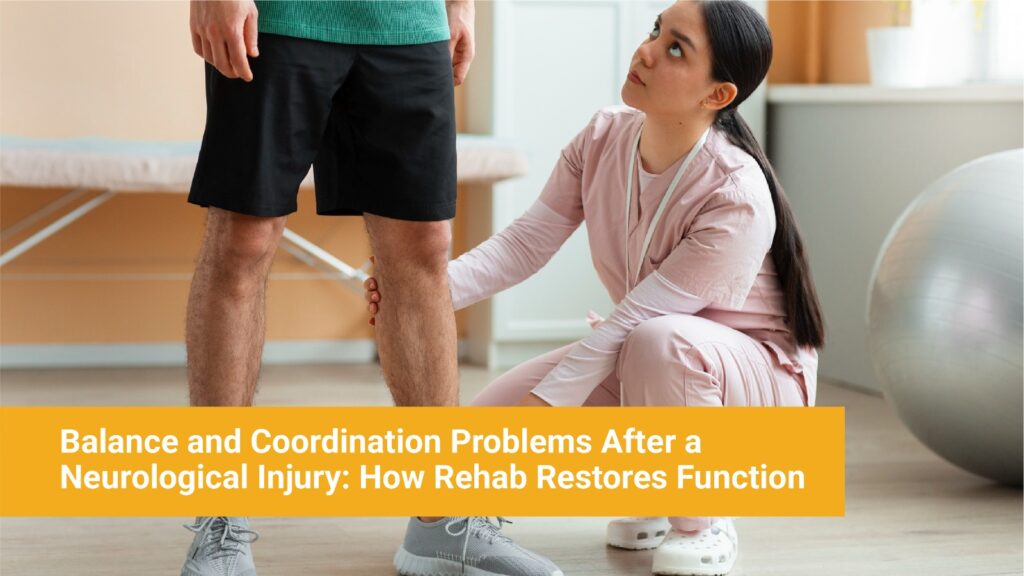
Balance and coordination difficulties are among the most functionally limiting symptoms of any neurological injury. They are also among the most underestimated things to be considered by families. A patient who appears to be making physical progress may still be at a higher fall risk that will cause harm over time or avoiding activity in ways that silently erode the gains made in formal therapy.
Understanding what can impact your balance after a neurological event, how rehabilitation addresses it and why timing and specialist input matter is essential for any family supporting a patient through stroke, brain injury, Parkinson’s, multiple sclerosis, or spinal cord conditions.
Table of Contents
ToggleWhy Balance Is a Neurological Problem, Not Simply a Physical One
Standing upright and moving through space without falling is not a passive, mechanical act. It is a continuous integration of signals from at least three distinct systems: the vestibular system in the inner ear, which detects head position and movement; the proprioceptive system in muscles and joints, which reports the body’s position in space; and the visual system, which provides environmental reference. The cerebellum and motor cortex synthesise all of this information in real time, generating the constant micro-adjustments that keep the body stable.
When a neurological injury disrupts any part of this system or several parts simultaneously – balance fails. The disruption is not in the legs. It is in the signalling. This is why strengthening the legs alone, without addressing the neurological deficit driving the instability, produces incomplete recovery at best.
How Different Neurological Conditions Affect Balance and Coordination
The mechanism varies considerably by condition, which is why balance rehabilitation must be tailored – not generic:
Neurological Condition | How It Affects Balance and Coordination |
Stroke | Damage to the cerebellum or motor pathways disrupts coordination and postural control on one or both sides |
Traumatic Brain Injury | Diffuse axonal injury affects the brain’s ability to process and integrate sensory information for balance |
Parkinson’s Disease | Reduced dopamine disrupts the motor control circuits that regulate gait initiation, posture and smooth movement. |
Multiple Sclerosis | Demyelination interrupts nerve signals causing coordination difficulties that fluctuate with the disease course. |
GBS | Peripheral nerve damage removes the sensory feedback the brain relies on to maintain balance and position sense |
Spinal Cord Injury | Disrupted motor and sensory signals between the brain and body impair postural control and coordinated movement. |
Balance Problems After Neurological Injury? Start Rehabilitation Early.
At Sukino’s neuro rehabilitation centre in Bangalore, Kochi, Coimbatore, Calicut and Hyderabad, balance and coordination rehabilitation is a core part of every neurological recovery programme – not an add-on once walking is attempted. Our physiotherapists, occupational therapists, and neuro-rehabilitation specialists work together to address the root cause of instability, not just its visible effects.
If your loved one is recovering from a stroke, brain injury, Parkinson’s disease, spinal cord injury, GBS, MS or another neurological condition, specialised neuro rehabilitation can make a significant difference in recovery. Contact Sukino’s neuro rehabilitation team to learn more about your personalised rehab plans.
How Rehabilitation Restores Balance and Coordination
Neuroplasticity – the brain’s capacity to form new pathways and adapt to injury – is the foundation of balance recovery. Rehabilitation exploits this capacity through structured, progressive challenge: exposing the nervous system to increasingly demanding balance tasks, so it is forced to adapt and reorganise. The programme components depend on which systems are affected.
What a structured balance and coordination rehabilitation programme addresses:
- Vestibular rehabilitation – retraining the inner ear and brain to process balance signals accurately
- Proprioceptive retraining – rebuilding the body’s sense of its own position in space
- Gait retraining – correcting abnormal walking patterns before they become a habit.
- Postural control exercises – restoring the automatic adjustments that prevent falls
- Dual-task training – practising balance while simultaneously performing cognitive or manual tasks
- Environmental adaptation – learning to manage uneven ground, stairs, crowds, and low-light conditions
- Falls prevention education – for both the patient and the family managing care at home
The Problem with Compensation Patterns
Left without specialist guidance, most patients develop compensation strategies – ways of moving that feel safer but that, over time, become obstacles to further recovery. A physiotherapist who understands neurological rehabilitation will identify and correct these early. Left uncorrected, they become habitual and progressively harder to unlearn.
Common compensation patterns that make recovery harder if left uncorrected:
- Leaning heavily to one side while walking can put an abnormal load on joints & risks further falls
- Holding furniture continuously prevents the brain from learning to balance independently.
- Avoiding any activity where balance is challenged accelerates deconditioning and loss of confidence
- Shortening stride length excessively is a protective habit that can become a permanent gait abnormality
- Over-reliance on vision to compensate for lost proprioception (functional in the short term, limiting long term).
FAQs
Balance is not maintained by the legs alone. It is a continuous, high-speed conversation between the brain, inner ear, eyes, muscles and joints – all feeding information to the cerebellum and motor cortex, which make constant micro-adjustments. When a stroke, brain injury, or spinal cord condition interrupts any part of that system, the whole conversation is disrupted. The result is instability, unsteady gait, and a heightened risk of falls.
Frequently yes – though the extent of recovery depends on the severity of the injury, which neurological systems were affected and how early structured rehabilitation started. Many patients achieve full functional balance recovery. Others make significant gains that meaningfully reduce fall risk and restore independence, even where complete reversal is not possible. The trajectory almost always improves with the right intervention.
Not with proper rehabilitation in place. Falls are common in the first months after stroke or brain injury – but they are not unavoidable. Structured balance retraining, home environment assessment, carer education, and appropriate assistive devices all reduce fall risk significantly. The goal of rehabilitation is not to protect the patient from all challenges but to build the skills and confidence to navigate the real world safely.
It varies considerably. Some patients with mild impairment recover functional balance within weeks of focused therapy. Others, particularly those with cerebellar damage or severe injury work on balance as an ongoing component of rehabilitation for months or years. Progress is not always linear – plateau periods are common – but most patients continue to improve well beyond the point where families assume recovery has stopped.
Many patients develop a fear of falling that is out of proportion to their actual risk – and that fear itself becomes a barrier, leading to reduced activity, further deconditioning, and ironically, a higher fall risk. Good rehabilitation addresses this directly through graduated exposure to challenging balance situations, building confidence alongside skill, and involving the family in understanding what is safe to encourage.
As a core component of every neurological recovery programme, not an afterthought once basic walking is achieved. Sukino’s team begin balance assessment early, identifies the specific neurological cause of the instability, and builds a graduated programme that addresses vestibular function, proprioception, gait mechanics, and real-world navigation – with the patient’s independence and safety as the measure of progress.

We are India’s first comprehensive continuum care provider. We provide multidisciplinary out of hospital care to acute and post-acute and chronically ill patients at our critical care facilities and your home.
- Sukino Healthcare
- Sukino Healthcare