
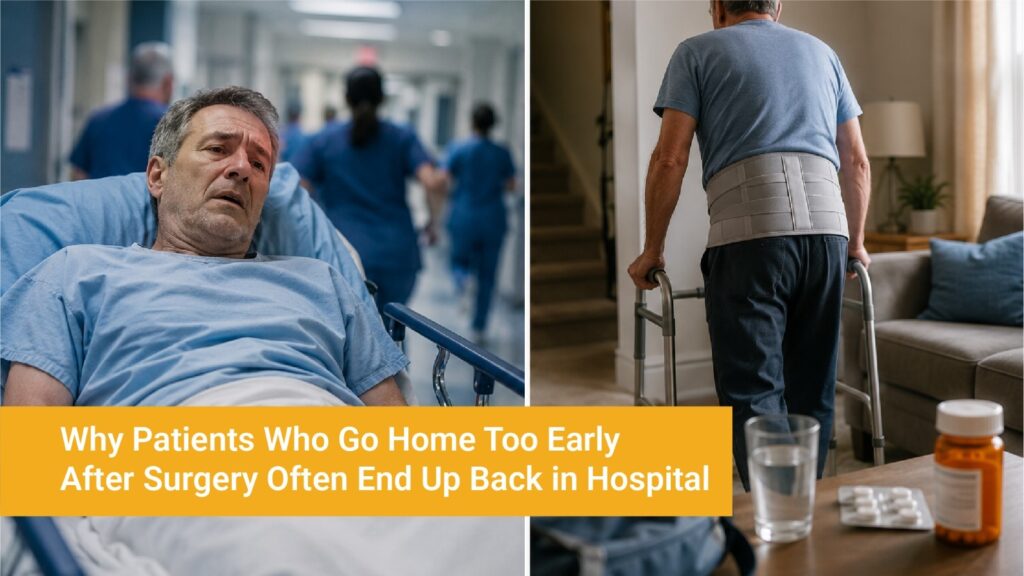
A 68-year-old man in Kochi had a knee replacement – a planned procedure, well-executed, with no complications in theatre. Three days later, he was home. The family was relieved. Everyone agreed he was doing well enough to leave.
Six days after that, he was back in the hospital. A wound infection, a high fever, and muscle weakness so pronounced that he could barely stand. What followed was three weeks of treatment for something that, with the right post-surgical support in place, was entirely preventable.
This story is not unusual. Across India, early hospital discharge after surgery is common – driven by bed pressure, insurance limits and the simple human desire to get home. But the gap between leaving the hospital and being truly ready to manage at home is where recovery most often goes wrong.
Table of Contents
ToggleWhy Early Discharge After Surgery Happens
In most cases, early discharge is not anyone’s fault in isolation. Hospitals across Bangalore, Kochi & Coimbatore operate under real capacity constraints. Insurance policies have fixed authorised durations. Patients and families, understandably want the comfort of home. And on paper a patient who is medically stable can look ready to leave.
The problem is that medical stability – no active bleeding & no immediate danger – is not the same as recovery readiness. A person can have a clean wound, a steady blood pressure and still be weeks away from safely managing on their own
What Goes Wrong: The Most Common Post-surgical Complications
When post-surgical care is inadequate whether because patients go home too early or because the right support is not in place these are the complications that bring them back to the hospital:
Complication Risk | Why It Happens at Home |
Wound infection | No trained eye checking sutures, dressings changed when convenient or incorrectly |
Deep vein thrombosis | Immobility at home with no structured mobilisation plan, compression therapy or scheduled position changes |
Medication errors | Complex post-op regimens managed without clinical oversight |
Muscle deconditioning | Physiotherapy delayed or skipped as the patient is in pain and the family does not want to push |
Falls & re-injury | Home environment not adapted; family not trained in safe transfer techniques |
Pneumonia | Reduced movement and poor respiratory exercises after general anaesthesia |
The Gap Nobody Plans For
Most surgical teams are excellent at the operation itself. Discharge planning, however, is often a brief conversation on the morning of departure. The patient receives a printed sheet of instructions, a follow-up appointment in two weeks, and a wave goodbye.
What that sheet cannot provide is someone to notice, on day four, that the wound is starting to look wrong. Or a physiotherapist who catches that the patient is compensating in a way that will damage the new joint. Or a nurse who spots the medication is being taken incorrectly. Early discharge creates a gap and complications fall into it.
Don't Let an Early Discharge Undo Your Surgery
Sukino’s post-surgical rehabilitation programmes in Bangalore, Kochi and Coimbatore are designed to bridge exactly this gap – from hospital discharge to confident, safe, full recovery. Our team monitors your healing, rebuilds your strength, and makes sure you go home once – not twice.
Warning Signs to Watch for After Going Home
Families managing post-surgical care at home should know what to look for. These symptoms require immediate medical attention:
- Fever above 38.5°C or chills
- Redness, swelling or discharge at the wound site
- Shortness of breath or chest pain
- Sudden confusion or extreme fatigue
- Inability to walk, eat or manage basic tasks
If any of these appear, do not wait. Contact your care team or visit a facility immediately.
What Post Surgical Rehabilitation Actually Provides
A structured post-surgical rehabilitation programme does not replicate a hospital. It fills the specific gap between clinical discharge and genuine recovery. At Sukino, this looks like:
- Daily physiotherapy to restore strength, range of motion and safe movement
- Wound monitoring and professional dressing changes on a schedule that is clinically determined
- Medication management and nutrition support
- Occupational therapy to rebuild independence in daily tasks
- Family training so caregivers understand what to do and what to watch for so the first sign of a complication does not go unrecognised for days.
- Regular clinical review to catch problems before they become crises.
For many patients, particularly those who are elderly, living alone, or recovering from major orthopaedic or cardiac surgery, a short period at a rehabilitation centre after hospital discharge is not a step backwards. It is the reason they do not end up back in the hospital.
FAQs
Signs include:
- Needing help with basic tasks like bathing or walking
- Ongoing pain that is not well controlled
- An open or draining wound
- Confusion
- A family with no training in post-operative care.
If any of these apply, raise them with your doctor before leaving.
Post-surgical rehabilitation is a structured programme of physiotherapy, occupational therapy, nursing care and monitoring that bridges the gap between hospital discharge and a safe return home. It prevents complications, restores strength, and dramatically reduces the risk of readmission.
Joint replacements (knee and hip), cardiac surgeries, abdominal procedures, spinal surgeries and major orthopaedic repairs are among those where structured post-operative care makes the greatest measurable difference to outcomes.
Families can play an important supportive role, but most are not trained in wound management, physiotherapy exercises, medication monitoring, or recognising early warning signs. Professional rehabilitation care significantly reduces the burden on families and the risk of errors.
This depends on the type and complexity of surgery, the patient’s age, baseline fitness and existing health conditions. For major surgeries, structured rehabilitation of two to six weeks is common, with ongoing outpatient support beyond that.
Sukino offers integrated post-surgical care including physiotherapy, occupational therapy, wound and medication management, nutritional support, and family counselling – all delivered by specialists at our Bangalore and Kochi centres.
For many patients especially those who are elderly, living alone, or recovering from major procedures a short stay at a rehabilitation facility significantly improves outcomes compared to immediate home discharge. It is a planned bridge, not a last resort.

We are India’s first comprehensive continuum care provider. We provide multidisciplinary out of hospital care to acute and post-acute and chronically ill patients at our critical care facilities and your home.
- Sukino Healthcare
- Sukino Healthcare