
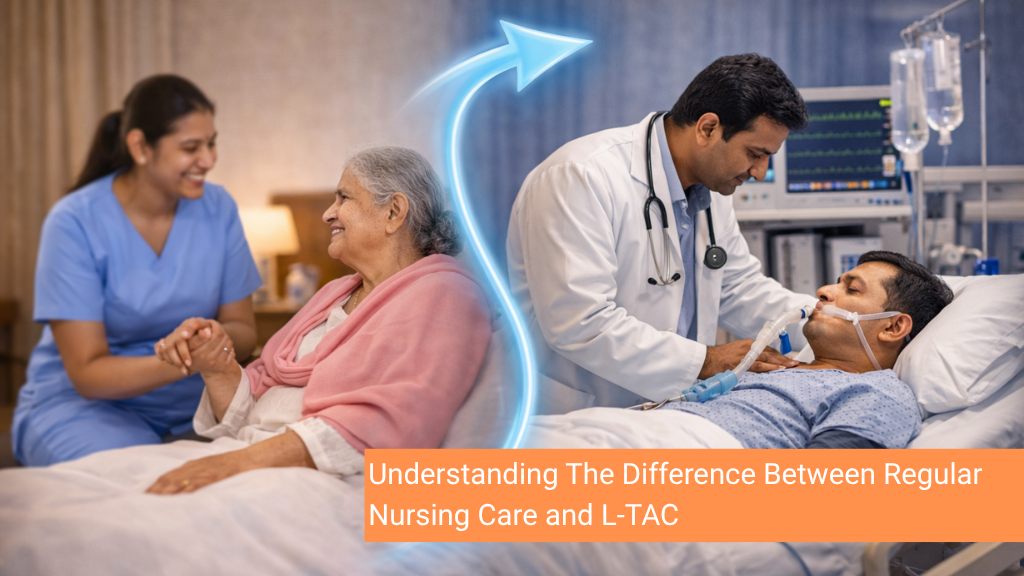
When a loved one becomes really ill, the journey does not often come to an end the minute a person leaves the hospital. There are a vast number of instances where the patient is medically stable enough to go home, yet too fragile to heal without immediate medical attention.
It is here that families often wonder whether to provide the patient with a standard nursing facility or if they have more specialised needs.
The distinction between Nursing Care and L-TAC ( Long-Term Acute Care ) can significantly affect recovery outcomes. Although both offer care outside the hospital, they address very different needs. Providing regular nursing care, though dedicated, is not enough, and it results in patients developing complications and hospital readmissions.
Let’s understand the difference between the two modalities of care
Table of Contents
ToggleWhat is regular nursing care?
Frequent nursing services normally revolve around the support of everyday activities and administering simple medicine. It is best applied to stable patients who mostly need assistance with their daily needs but not close supervision.
Regular nursing care patients usually require aid in:
- Medication management.
- Mobility assistance.
- Personal cleanliness.
- Wound dressing.
- Basic physiotherapy.
- Monitoring vital signs.
This level of care might be useful to many elderly patients who have undergone minor surgeries or have chronic conditions.
The environment is normally tailored to give comfort and support as opposed to concentrated medical care. Nurses make sure patients will feel secure, comfortable, and assisted in their everyday lives. Nevertheless, routine nursing is not capable of dealing with complex or critical medical care.
What is specialized care or Long-Term Acute Care (L-TAC)?
Long-term acute care, also known as L-TAC, is a highly specialized form of patient care to serve the patients who are stable and yet critically require medical assistance.
Such patients could have survived a serious disease, surgery, or ICU, but still need a high level of clinical care and multidisciplinary treatment. The L-TAC facility is a bridge between full recovery and intensive care in hospitals.
This modality of care may be required in patients who frequently require:
- Ventilator therapy/ventilator weaning.
- Tracheostomy care.
- Patient-advanced respiratory therapy.
- Constant clinical observation.
- Complex wound management.
- Feeding tube management.
- Formal physiotherapy and rehabilitation.
As compared to the ordinary nursing care, the L-TAC centres have hospital-level clinical management and specialised medical teams. It is not only about comfort or supervision. The aim is active recovery and stabilisation, which helps the patients to become stronger and more self-sufficient step-by-step.
Why the difference matters
To the family members going through the recovery of a loved one, the decision on the appropriate level of care may become daunting. On the face of it, there may seem to be no difference between the two. They both offer nursing care in a non-hospital setting. However, the nature of care that the patient needs dictates the choice made.
A patient still in need of complex respiratory care or constant supervision might not get the care that they can get in a typical nursing setup.
Likewise, it might not be necessary to put a stable patient in a facility with a high-acuity.
The correct choice is one made based on the level of recovery of the patient.
L-TAC is especially valuable with patients who are recovering from a major illness, such as:
- Stroke or brain injury.
- Prolonged ICU stays.
- Critical infections such as sepsis.
- Major trauma or accidents.
- Complex surgeries.
- Respiratory failure.
- Neurological disorders.
Such patients are normally referred to as being in a critical recovery stage.
They do not need ICU care anymore, but they are not ready to receive home care and ordinary nursing help; otherwise, recovery can be slowed down or troublesome.
The multidisciplinary care role
The multidisciplinary team approach is one of the characteristics of L-TAC. The postcritical illness recovery is not always a one-dimensional process. A team of specialists working together is often needed by patients.
This team may include:
- Critical care physicians.
- Rehabilitation specialists.
- Physiotherapists.
- Respiratory therapists.
- Speech and swallowing therapists.
- Nutritionists.
- Complex care nursing teams.
They develop a comprehensive recovery plan that suits the needs of the patient. This enables patients to progressively gain strength, enhance the ability to breathe in and out, restore disability, and rebuild mobility and vital functions.
Helping families in the recovery process
One very significant distinction between normal nursing care and L-TAC is with regard to the assistance offered to families. Critical illness is not only limited to the patient, but to his or her loved ones as well. The families are usually confused about what to expect upon discharge. The L-TAC centres generally lead families through the process of the recovery process, making them aware of progress, treatment regimen, and setting realistic expectations. This can help a lot in difficult moments.
The L-TAC facilities are important in assisting patients to transition to meaningful recovery rather than survival by offering specialised medical service, rehabilitation, and monitoring in a highly organised setting. The knowledge of this difference enables the family to make wise choices, making sure that the family members obtain appropriate care at the appropriate moment on their way to recovering their health.

We are India’s first comprehensive continuum care provider. We provide multidisciplinary out of hospital care to acute and post-acute and chronically ill patients at our critical care facilities and your home.
- Sukino Healthcare
- Sukino Healthcare